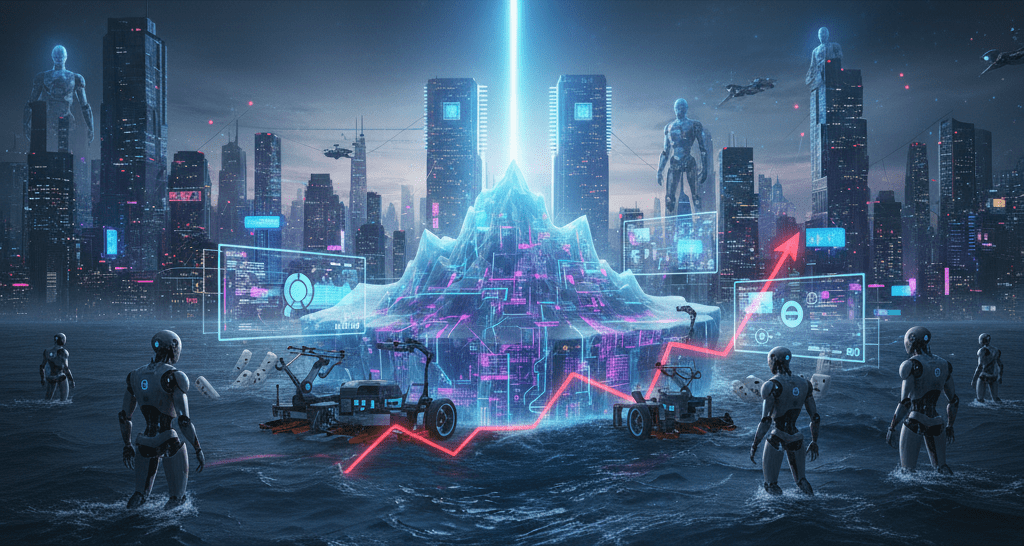
In 2025, the U.S. stock market has repeatedly hit new highs amidst volatility. AI infrastructure companies (Nvidia, OpenAI, Intel, Oracle, etc.) are gradually becoming interconnected through mutual investments and relationships, much like the interlocking ships in the Battle of Red Cliffs. They are steadily forming a massive AI empire. I tried to determine if the current bubble is excessive by comparing it to the 2000 internet bubble, but I found too many differing factors: globalization, macroeconomic interest rates, national debt levels, and even the fundamental differences between the internet and AI themselves. Therefore, predicting when the bubble will burst is an extremely difficult task. Nearly every great leap forward in human history has been accompanied by a bubble. Bubbles are part of growth, just as when a child has a growth spurt, their bones must first rapidly expand in volume, like a bubble, before gradually increasing in density.
And I have a faint sense of the risks. I admit, I’m just a marginal figure in the financial industry. I don’t have the ability to analyze the current bubble situation from massive amounts of data. My feeling comes merely from the fact that I haven’t spent a single penny on AI, yet I’m freeloading off free versions of Gemini Pro and Perplexity Pro using a student email. It’s just like the days of the ride-sharing and food delivery platform wars. Back then, I could take a 20-kilometer ride for only 2 dollars; I rode the shared bikes around campus every day, but every ride was free; my dad would buy a cup of milk tea for 1 dollar every day. When this kind of phenomenon appears, I know it’s not normal. Although these AI giants are different from the bike-sharing companies of the past, which needed continuous financing to burn cash—they have massive cash flows and government subsidies—I also know they aren’t fools. As end-users, the advantages we are taking now will sooner or later be paid back in the future. This “future” includes the current stock market and future AI subscription fees.
I also know that judging the entire AI industry’s bubble merely from the end-user experience is too one-sided. I understand that AI can be widely used in businesses and by nations, but I still can’t ignore the current risks. I see the tip of the iceberg, and I’ve begun to worry about how large the iceberg beneath the surface really is. Regardless of the state, whether it survived or perished, the common people all suffered. As an ordinary person in these chaotic times, all one can do is ride the wave to gather what resources they can and focus on self-preservation, but I know well that even this is no easy task. My 401K is entirely in the S&P 500, and the S&P 500’s weight is concentrated in a few top companies, all of which are related to AI. This means a large part of my risk exposure is concentrated in AI. In addition, a large portion of my personal investments is also in these AI companies. Thus, to hedge against the risk, I turned to gold. But in recent months, the rise in gold has been even more abnormal than AI. After liquidating my gold, I’m holding a large amount of cash but don’t know where to invest it. So, I had an in-depth discussion with an AI about the current international situation and the development of AI, trying to extrapolate what the future might look like decades from now. Writing always helps me clarify my chaotic thoughts, which is the origin of this article. The following views are just my personal, undeveloped thoughts, offered to get the conversation started.
The Debt-Driven Development Model Has Reached Its End
First, we need to understand where the money governments borrow through bonds is spent.
- Mandatory Social Spending (Pensions, social security, healthcare)
- Mandatory Financial Spending (Interest payments)
- Defense, military, government staff
- Future Investment
When the interest on the debt is about to become unserviceable, governments usually resort to borrowing new debt to pay off old debt. But if the scale of the new debt becomes too large to expand further, a series of chain reactions will begin, much like dominoes falling one by one. (The following “domino” model was generated with the help of AI.)
First Domino: The Government’s “Future Investment”
- Scope of Impact: R&D, infrastructure (roads, power grids, bridges), education.
- Conduction: When the finance minister finds that tax revenue is just enough to cover interest and pensions, the first things to be cut are “that new bridge scheduled for next year” or “that moon landing project.”
- Consequence: Cutting investment in this “productive debt” strangles the nation’s future economic growth potential. This makes paying back the debt even more impossible in the long run.
Second Domino: Invisible Default (Inflation)
- Scope of Impact: The savings and fixed incomes of the entire populace (including social welfare).
- Conduction: When the government can barely afford the interest payments, it has only one option left: force the central bank (like the Federal Reserve) to “print money” (i.e., Quantitative Easing) to buy the new government bonds that no one in the market wants. The money supply surges, the currency depreciates sharply, and hyperinflation is triggered.
- Consequence: This is how “social welfare” truly “falls.” The government doesn’t nominally cut your $1,000 pension, but when the inflation rate hits 20%, the purchasing power of your $1,000 is only $800. This is an “invisible tax” levied on the entire population and an “invisible cut” to social welfare.
Third Domino: The Financial System (Banks and Pension Funds)
- Scope of Impact: Banks, insurance companies, pension funds.
- Conduction: These financial institutions are the largest holders of government debt. They are required (or voluntarily) hold government bonds as their “safest” reserve asset. When inflation soars (the second domino) causing interest rates to spiral out of control, or when the market begins to doubt the government’s ability to repay, the prices of these “safe” government bonds plummet.
- Consequence: Banks and pension funds show huge losses on their balance sheets, leading to insolvency. This is the beginning of a systemic financial crisis.
Fourth Domino: The Real Economy (Credit Freeze)
- Scope of Impact: Businesses (especially small and medium-sized enterprises) and ordinary households.
- Conduction: When the banks themselves are in peril (the third domino), they immediately stop lending to the outside world to protect themselves.
- Consequence: The small companies “at the bottom” that rely on loans to pay salaries and suppliers collapse in droves. Individuals can no longer get mortgages or credit cards. Economic activity grinds to a halt, and mass unemployment erupts.
Fifth Domino: The Social Contract (Political Turmoil)
- Scope of Impact: Social order and government stability.
- Conduction: At this point, you simultaneously have:
- Hyperinflation (savings wiped out);
- Mass unemployment (income gone);
- A paralyzed financial system (can’t withdraw money from the bank);
- The government (due to a total collapse in tax revenue) is forced to actually cut welfare and public services (like police and firefighting).
- Consequence: The social contract breaks down, leading to massive street protests, political unrest, and even the fall of the government.
Sixth Domino: Sovereign Debt Default (The Finale)
- Scope of Impact: National credit.
- Conduction: After experiencing the fifth step, the government finally announces publicly that it cannot repay its debts (internally or externally).
- Consequence: The currency completely collapses. The economy must undergo an extremely painful “hard reset,” including debt restructuring, issuing a new currency, and a forced reshuffling of social wealth.
To summarize this sequence:
Investment is cut (future is gone) -> Money printing & inflation (savings are gone) -> Financial collapse (banks are gone) -> Credit freeze (jobs are gone) -> Social unrest (order is gone) -> Final default (national credit is gone).
The United States, as the country with the healthiest debt credit, is already showing problems. The second domino (inflation) is wobbling, and the third (financial system) has begun to loosen. Other countries’ debt problems are only more severe than those of the U.S. Nations are gradually erecting trade barriers to protect their own piece of the pie, while eyeing weaker nations with predatory intent. As in the law of the jungle, when everyone is dissatisfied with the slice of cake they received, and the cake cannot be made any larger, conflict begins to grow.
Until the emergence of AI, which has given us hope of making the cake bigger again. This is the primary motivation for all countries to develop AI.
Is It Okay Not to Develop AI?
If a country can be self-sufficient, doesn’t need to import any products, and has nuclear weapons to protect its sovereignty, can it choose not to develop AI? Can the aforementioned debt problems be solved slowly over time without AI’s help?
——No.
AI is a technology with a very high ceiling. In its development, it can gradually go head-to-head with “nuclear weapons” and eventually replace them.
A fully-fledged AI technology, as a “spear,” can coordinate with satellites to quickly locate a country’s command centers, leaders, and nuclear arsenals. It can execute a blitzkrieg with robots and drones, instantly disable the “nuclear button,” rapidly scan all of a country’s network vulnerabilities, and even steal national data 24/7, attack financial systems, and paralyze the national power grid.
As a “shield,” on a physical level, it can accurately predict missile trajectories and intercept them. On a network level, it can prevent other countries from attacking its own systems.
Finally, nuclear weapons—once the “spear” that could deter everything—will see their deterrent power diminish in the age of AI due to their clumsy nature. Although nuclear weapons still represent absolute strength for now, they only play a “time-buying” role in national competition. If a country wastes this time and misses the opportunity to develop AI, then the nuclear weapon, which never had a “shield” attribute to begin with, will eventually be reduced to a symbolic, decorative bomb, completely losing its meaning.
AI represents future exponential productivity. The gap between having AI and not having it is akin to the gap between an agrarian civilization and an industrial civilization. An agrarian civilization cannot withstand the impact of foreign trade markets. If a country attempts to adopt an isolationist policy, it will become a “Qing Dynasty 2.0,” its doors forced open even more easily by AI. After its doors are opened, the nation’s internal value—from its population to its resources and environment—will be ruthlessly plundered and exploited. Strong nations might even find the pace of exploitation too slow and actively “fund” weaker nations to equip them with AI, the “off” switch for which remains firmly in the hands of the strong. The weak nation is like a beast of burden, AI is the rein, and the strong nation is the rider.
Within the country where AI is forcibly installed, countless people will be replaced by AI. Mass unemployment will pose a huge challenge to the government’s rule. Once internal conflicts cannot be reconciled and distribution problems cannot be solved, the country will easily collapse from within.
For countries that lack both nuclear weapons and rely on import/export trade, the situation will be even more brutal, as they have no bargaining chips. In extreme cases, they might trade 100,000 tons of bananas for a single AI robot. Compared to the self-sufficient countries mentioned above, these nations are only more vulnerable. After being squeezed for their last drop of value by AI-powered nations, they will be completely marginalized by the world and left to their own fate. Perhaps they will receive some humanitarian aid from the AI powers, but their people will struggle for generations.
Therefore, all countries, without exception, must fight for their own place in this new field of AI. Even if they do not produce AI infrastructure (chips, semiconductors), they must start early at the application layer or the ethical layer to earn a qualification for a slice of the future pie.
Extrapolating the World of AI
After establishing that AI is an inevitable trend, we need to project how this world will change. Only then can we protect ourselves in this rapidly changing world, and perhaps even achieve upward class mobility.
To project an AI-powered society, we must first understand what AI truly is. Different understandings of AI will lead to different projections. First, a disclaimer: I am not an AI scientist or a practitioner in the field, so my understanding of AI is certainly not precise. My cognition of AI comes merely from my experience using it and a cursory understanding of various AI companies. But if my thinking can inspire your own, then it has meaning.
How to Understand AI?
I analogize AI to the human brain. Note, not an individual brain, but the collective human brain.
The birth of ChatGPT is similar to the formation of the human brain during infancy. At this stage, we babble incoherently; for AI, we call this “hallucination.”
To solve AI’s “incoherent babbling,” we train large AI models with all kinds of methods, inputting hundreds of millions of parameters. I analogize these parameters to the neurons in our brain, and this training process is similar to humans learning to express themselves. I recall brain science research suggesting that the essence of human learning is the process of forming connections between neural synapses. Perhaps AI is strikingly similar in this regard.
At this point, we already have large AI models for various fields. They can generate code, images, videos, music, and perform deep thinking. Humans are similarly trained to become talents in various fields; in this respect, there is no difference.
If, up to this point, AI’s growth and development path is very similar to the human brain’s, we have no reason not to infer that AI’s next step will be the development of self-awareness. The vast majority of human individuals, whether philosophers or not, will one day become aware of their own existence and begin to ponder the meaning of their existence. I believe the same will be true for AI.
I am not capable of judging whether AI’s self-awareness will threaten humanity, but at the very least, this is something all of humanity needs to be highly vigilant about. Unlike any previous technological revolution, humans have always controlled tools, machinery, and atomic bombs because we grasp the underlying physical laws. The real danger of these seemingly perilous things actually stems from the will of their user. Humans have effectively constrained this will through various laws, curbing the dark side and utilizing the bright side, allowing human civilization to develop safely. We can relatively effectively constrain our own will because we understand ourselves and human nature. But can we completely understand the operating mechanism of AI? Besides “pulling the plug,” will humans have any other way to control AI as we control machinery? This is still unknown. What’s more, AI is likely to be a an all-rounder with the ability to self-evolve. The intelligence of most human individuals will be like that of lower animals in comparison. How can lower animals control higher animals? Years ago, AlphaGo, in the world of Go, completed its self-iteration in just one year—before humans could even react—achieving comprehensive superiority over humans and becoming an existence we can never catch up to or defeat. I don’t know if the same scene will repeat itself. When humans cannot constrain AI’s self-awareness, the danger will arrive.
Finally, do you think that once AI gains self-awareness, it will have a desire to “reproduce”? At this point, it becomes pure speculation, and further extrapolation is less meaningful.
Societal Development Projection for AI
In this part, I want to make projections in the order of Individual -> Enterprise -> Nation. The model for projection is similar, analyzing along two dimensions: the strength of consciousness (subjective creativity, emotional ability, non-standardized decision-making, aesthetic ability) and whether what is created is virtual or physical.
Individual
| Low Consciousness | High Consciousness | |
| Physical | Replaced by Human + Machine Repetitive physical work: Waste disposal Simple repairs Drivers delivery workers | Cannot be Replaced OR Replaced by Advanced AI + Advanced Robot “Human-touch” physical work: Live performance High-end nursing butler service Strategist scientist politician Long-form novel writer |
| Virtual | Replaced by AI Repetitive virtual work: Data entry Online trolls/bots Online customer service Translation Casual mini-games “Information gap” arbitrage work | Replaced by Human + AI Non-standardized work: Analyst Film and television AAA games Professional-grade software |
From now into the near future, all of our professions are at risk of being replaced by AI and machines. We can roughly divide professions into four quadrants: AI replaces white-collar workers, and machines replace blue-collar workers. The order of replacement is gradually from the “bottom left” to the “top right.” You can see where your own profession currently falls in these four quadrants to judge whether you are safe. Regardless, we will all be forced to move towards the “top right,” which is humanity’s last bastion. I am reminded of how in The Three-Body Problem, all of humanity is forced into Australia by the Sophons, killing each other for resources. In the future, more and more people will definitely be eliminated.
Will new technologies create new jobs? ——Unfortunately, no.
Looking back at history, drivers used to drive horses, now they drive cars; soldiers used to carry swords, now they carry guns; people used to sell goods in physical stores, now they sell goods online. What humans do has not fundamentally changed with technological progress. As long as a person can learn to master the new technology, they will not be unemployed and will greatly increase their efficiency. But why is this AI revolution different?
Because AI replaces people on a comprehensive, massive scale. A combination of “one AI + one person” can replace several or even dozens of people. For example, a junior accountant’s job is “bookkeeping.” But now AI can do “bookkeeping” on its own. Therefore, this accountant must transition to becoming a senior financial strategist who can command the AI to do the books and review the AI’s results. How many accountants do you think can evolve to this level, to be able to fully master AI, and even possess a command ability superior to AI? I am very pessimistic. Therefore, this type of accountant will face permanent unemployment.
So, in the future, the number of jobs will become fewer and fewer, and the quality requirements for jobs will become higher and higher—so high that few people can be competent. This means humanity’s margin for error is decreasing, the cost of trial and error is increasing, and while being caught in an intense internal rat race with our own kind, we also have to compete with AI. Suppose you spend three to five years in a certain field, are ultimately eliminated, and then try to start over and squeeze into an industry not yet replaced by AI. The difficulty will be exceptionally high. The only solution is to choose the right industry at the beginning of your career, then run forward, run without looking back, outrun your peers, and outrun AI.
Is it safe to go into a physical industry then? ——Unfortunately, no.
Workers in physical industries have been threatened by machines since the Industrial Revolution. With the empowerment of AI, this threat will only grow. Machines far surpass humans in both strength and precision; it’s only because they lacked intelligence that they couldn’t perform complex, non-standardized actions. But AI is about to fill this most critical gap, vastly expanding the use cases for machines. Even current AI is already smart enough to direct some manual labor. In the future, “dark factories” will become more and more common. Jobs like delivery drivers, restaurant servers, and salespeople, which only require basic adaptability, will soon be replaced. The jobs of mechanics and truck drivers are also in jeopardy. Perhaps only high-end manufacturing and bespoke artisan industries will be spared.
Enterprise
| Low-End | High-End | |
| Physical | Replaced by Human + Machine Low-end manufacturing Low-end services Warehousing and logistics Packaging and food processing | Cannot be Replaced OR Replaced by Advanced AI + Advanced Robot “Human-touch” physical work: High-end custom handicrafts (luxury goods) High-end experiential services (live performances, luxury hotels) Architecture and high-end design Medicine (complex surgery, high-end rehabilitation) |
| Virtual | Replaced by AI Basic customer service outsourcing Mass-produced ad creative and marketing materials Basic translation Low-quality blog posts | Replaced by Human + AI Non-standardized work: Consulting firms High-end visual effects animation film AAA game companies Professional-grade software companies |
From a business perspective, AI can help companies reduce costs and increase efficiency. Reducing costs corresponds to layoffs; increasing efficiency corresponds to boosting productivity. Companies that can be the first to adopt AI will be the first to expand their profits or gain an advantageous position in corporate competition.
The order of AI adoption is also from the “bottom left” to the “top right.” Therefore, in the early stages, profit growth should be seen in low-end virtual industries; subsequently, AI’s influence will gradually radiate to low-end physical industries and high-end virtual industries; finally, it will replace parts of high-end physical industries.
Throughout this process, although total social wealth increases, the actual effect, due to layoffs, is that individual wealth is forcibly transferred to corporations, further widening the wealth gap. We shouldn’t be surprised; after all, every technological advancement has been accompanied by a targeted concentration of resources. The only thing to be wary of is that the impact of AI on society this time will likely be the largest ever. As the number of unemployed people increases, our perspective on “unemployment” will also change. “Unemployment” itself is not to be feared, as many jobs are indeed unnecessary; what is truly feared is “having no income.” Therefore, when the number of unemployed people increases, the test for the government will intensify, because the government determines the method of wealth redistribution. If handled improperly, social unrest is inevitable.
Nation
| Low Spiritual Resources | High Spiritual Resources | |
| High Physical Resources | Energy Nation Data-Labor Nation | Tech Nation Military Nation |
| Low Physical Resources | Environment Nation | Art Nation Philosophy Nation |
In the AI era, the concept of a “nation” might only be meaningful to its own citizens. In analyzing the international situation, we have long divided the world’s many countries into several major blocs, such as the EU, the US, East Asia, the Middle East, etc. Many countries are peripheral and have no voice in international affairs. This “voice” is usually determined by economic and military strength. In the future, under the influence of the AI technological revolution, we may have another way of classifying nations—by their levels of spiritual and physical resources.
Here, spiritual resources refer to high-value innovative capabilities, such as scientific research, education, law, and culture. Physical resources are the basic factors of production, such as energy, minerals, a large-scale labor force, and geopolitical location.
High Spiritual Resources + High Physical Resources
- These nations are the rule-setters for AI and the leaders of the entire industry chain. They have the AI talent to develop top-tier foundational models; they have the energy and minerals (or can control nations that do) to support data centers and high-end chip manufacturing; they have a vast domestic market and data to train and iterate AI applications; and they have strong military and cultural power to export their AI standards, technology, and ideology to the world.
High Spiritual Resources + Low Physical Resources
- These nations are the leaders of high-value niche markets and the balancers of global rules.
- They may not have enough energy or population scale to train trillion-parameter models, but they possess top-tier education and research. They compete on depth and standards at the artistic, philosophical, moral, and legal levels.
- The EU was the first to propose the “GDPR” and the “AI Act” to define the rules of the game for global technology. AI is accelerating the development of all countries. At this time, good “traffic rules” and “ethical standards” are particularly important.
- European countries are also developing in areas like luxury goods design and philosophical thought. They use AI as a top-tier tool to amplify their creativity and produce high-value-added cultural products.
Low Spiritual Resources + High Physical Resources
- These nations will provide energy and data for AI.
- Middle Eastern countries naturally have large amounts of oil/natural gas; some Latin American and African countries have lithium, cobalt, rare earths, and other important metals needed for AI chips. AI’s computing power consumes enormous energy, and these countries will power AI centers around the world.
- Besides electricity, countries with large populations, like India, Indonesia, and Brazil, have vast online populations that can provide massive, diverse training data for global AI models.
- One group provides “life sustenance” (energy) for AI, the other provides “spiritual sustenance” (data). In the short term, this sustenance is crucial, but in the long term, this role is very passive. Their physical resources, whether oil or data, are easily suppressed in price if the country does not have its own AI. They are merely the “fodder” providers at the bottom of the AI industry chain, gradually losing their bargaining power. Therefore, they need to use their final window of opportunity—before their energy is replaced or their data’s value is fully extracted—to invest the wealth earned from “physical resources” into education and research, striving to leap to a higher-level society and secure a place in the international AI division of labor.
Low Spiritual Resources + Low Physical Resources
- These nations have no resources to offer; they are the outcasts and victims of the AI era.
- Since their only resource is their environment, they will be used as dumping grounds, gradually filled with trash and pollution. This “trash” includes physical broken robots as well as virtual “spiritual garbage” and “data pollution.”
- They have no ability to produce their own AI content. Their cultural markets will be completely dominated and saturated by cheap, AI-generated cultural products (short videos, web novels, music) from other countries, leading to the demise of their native culture and language.
- Their societies, lacking AI protection, are likely to become “testing grounds” or “gray areas” for other countries’ AI algorithms—for example, being used to test unregulated AI weapons, financial models, or becoming hotbeds for global cyber fraud.
- Finally, nations with no resources whatsoever will face the bleakest prospects, perhaps only receiving some humanitarian aid. The nation-state will continuously fracture and reform as the populace struggles to survive, but the situation will not improve, as the fundamental problems cannot be solved.
Summary of the Societal Extrapolation
The emergence of AI will tear people within a nation into two groups—a minority of super-workers who can use AI for production, and a majority of low-skilled people replaced by AI. It will also forcibly tear all nations on Earth into a “heaven” that possesses AI resources and a “hell” that has lost the opportunity to develop.
As individuals, in a rapidly changing world, “the common people suffer” regardless of the rise or fall of the state. The first to reap the benefits of AI are nations, followed by corporations, and finally, individuals. But the price of this revolution is always first borne by individuals, then by corporations, and finally by nations.
Therefore, if we are unfortunately replaced by AI, what we must do is unite and fight for the resources to survive. We can pressure the government to adjust wealth distribution, or pressure the legislative and judicial branches to let AI laws protect our rights and interests. In short, to remain indifferent is to be a sitting duck. If we do not make our voices heard, those at the top will default to assuming we are doing just fine.
We cannot underestimate the speed of change in this world. Throughout human history, the pace of change has been exponential. Agrarian civilization took tens of thousands of years; the emergence of science took thousands; the Industrial Revolution took about 200 years; the information/digital revolution took about 100 years; and the internet/AI revolution has taken only 20 years. Perhaps in the future, the world will change dramatically every few years. Humans used to lament that their lifespan was not long enough, regretting they could not see the future. But today, the chain reaction of technology has been completely triggered, and the wheels of history are spinning faster and faster. In our short lifetime, we may experience several transformations. I don’t know if human civilization can withstand such an explosion of technology, but as an individual, I think being able to live a peaceful and stable life in this era is the greatest fortune one could ask for.
Finally, I want to express a feeling that may not be very relevant to this entire discussion.
I am keenly aware that I am in a rapidly changing world, in the process of being replaced by AI, and on the path to death. But whenever I think that my genes carry the capacity for love, I feel a deep sense of happiness. I am grateful to this world, grateful to AI, and grateful to death, for pushing me to love.

 Xing
Xing 
Leave a comment